
Billing calls arrive in the same window every cycle. For the first three days after bills go out, the queue fills with the same handful of questions, and most of them trace back to telecom invoice design. Any billing manager with a few years at a broadband or telecom provider could write the script from memory: “Why did my bill go up?” “What’s this charge on line four?” “I thought my rate was locked in.”
Most providers staff around that pattern. They add agents for post-bill days, train them on billing questions, and accept the volume as a cost of doing business. That’s a reasonable response if the problem can’t be fixed. It’s worth asking whether it can, because in many cases the invoice is creating those calls before the first customer picks up the phone.
Why the Same Calls Come Back Every Cycle
Telecom invoice design usually gets treated as a formatting question, and the billing team often has little say in it. Charge labels, wording, and layout are set by the billing system’s output configuration. That configuration was decided at implementation and rarely revisited.
The result is an invoice that records what was billed accurately but doesn’t explain it. A customer who signed up for “Fiber Internet 500/500” and sees “FBR-SVC-TIER3” on their statement won’t assume those are the same thing. They’ll call. An agent explains it, the call closes, and next month the same invoice goes out and produces the same call.
That’s why it helps to think of post-bill call volume as partly an invoice architecture problem, not only a support problem.
Telecom Invoice Design Fixes for the Five Line Items Behind Most Calls
A small set of line items produces far more calls than its share of the statement would suggest. Each one can be explained in a sentence, and that sentence belongs on the invoice.
1. First-Bill Charges
A new customer’s first invoice combines installation, equipment, a partial month, and the first full month. They were quoted one number and see four. Label each charge, and tell them what next month’s bill will be.
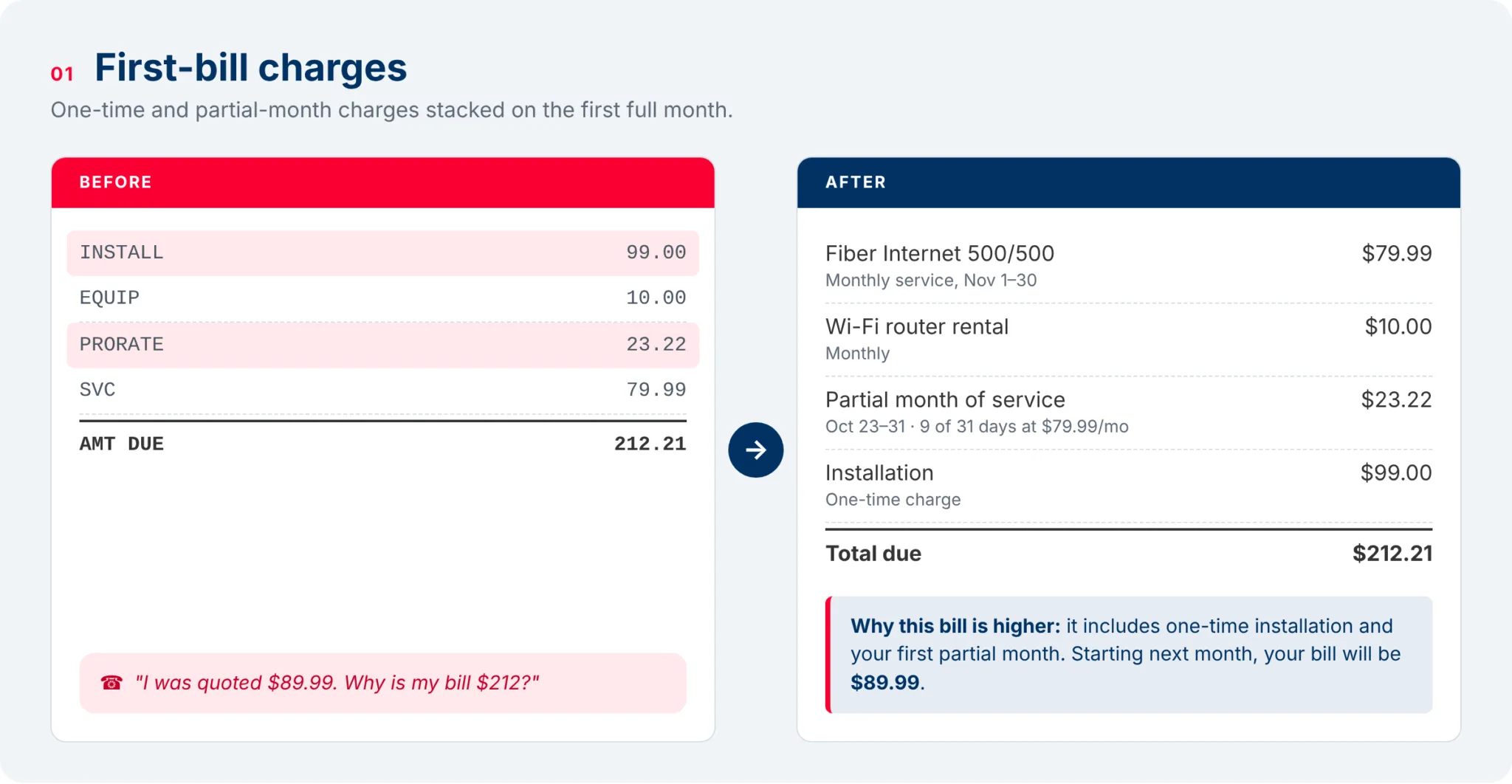
For the first bill in particular, a short personalized video that walks the customer through each charge can head off the call entirely.
2. Promotional Rate Expirations
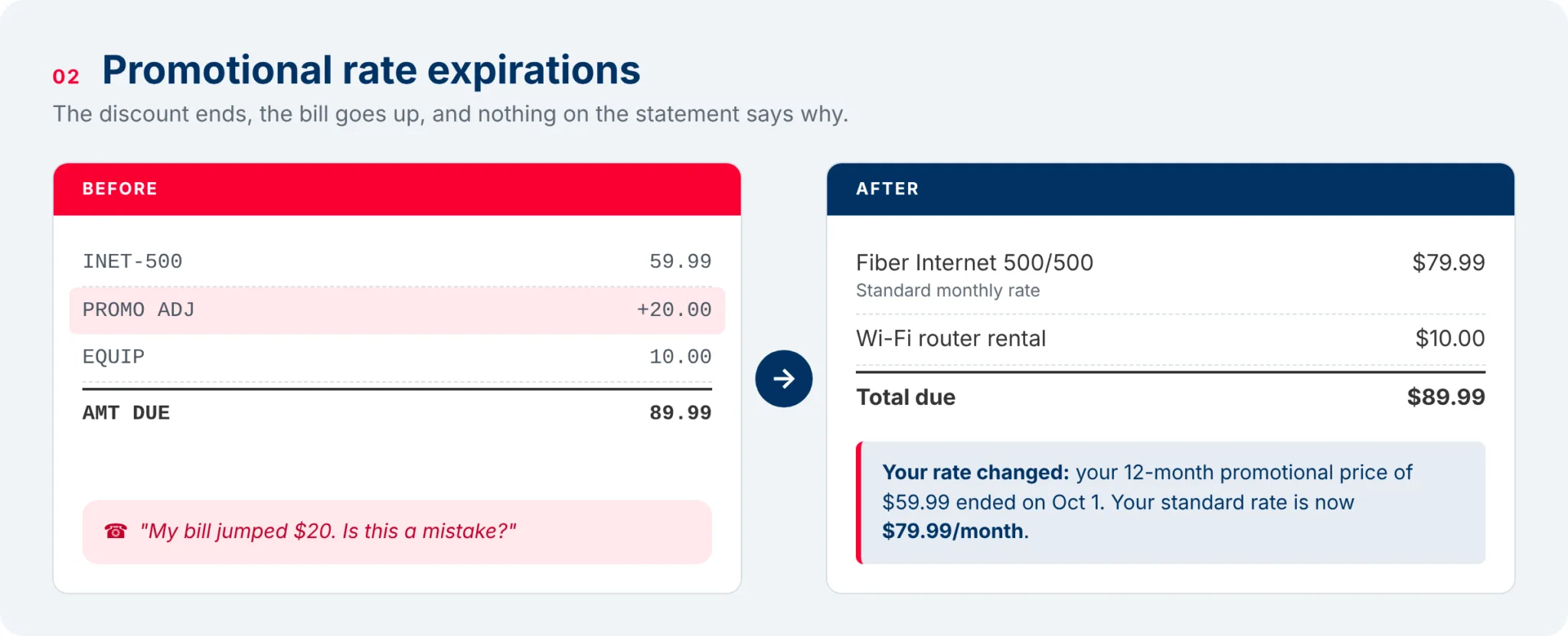
When a discount ends, the bill goes up, and customers rarely connect that change to an agreement they made a year earlier. One line next to the charge explains it.
3. Mid-Cycle Credits
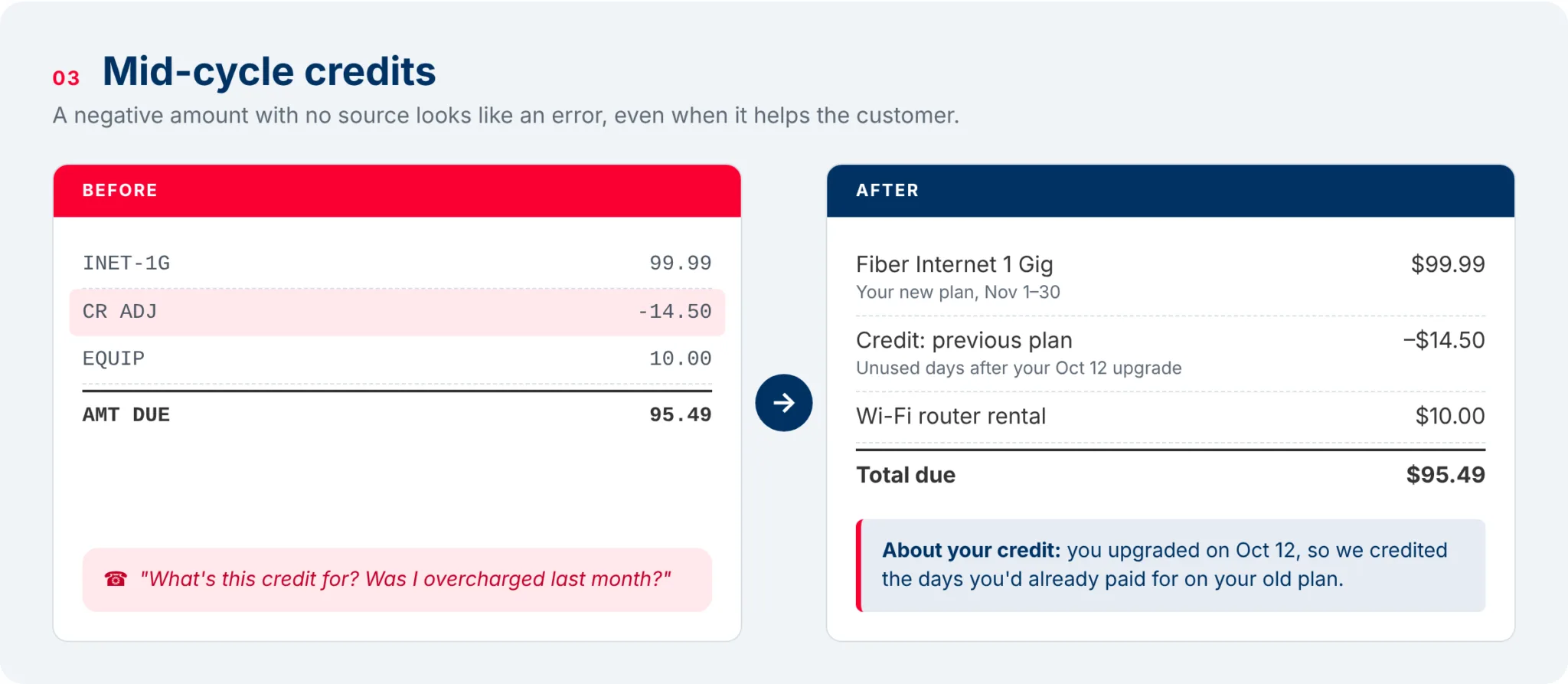
A negative amount with no source looks like an error, even when it works in the customer’s favor. Say what the credit is for and what triggered it.
4. Partial-Month Charges
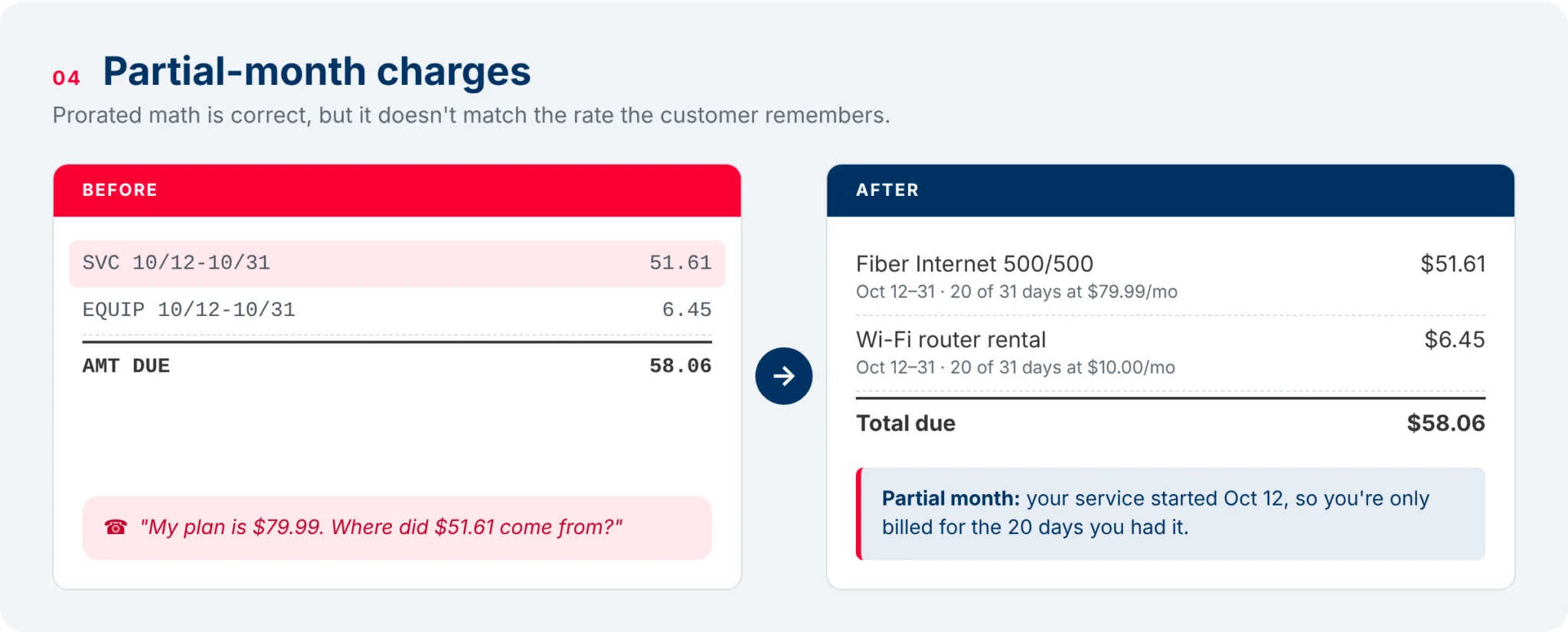
Prorated amounts are correct, but they don’t match the monthly rate the customer remembers. Show the dates and the day count so they can check the math themselves.
5. Taxes and Fees
Six small coded charges look like add-ons the customer never agreed to. Group them by who sets them: government taxes and fees in one group, provider fees in another.
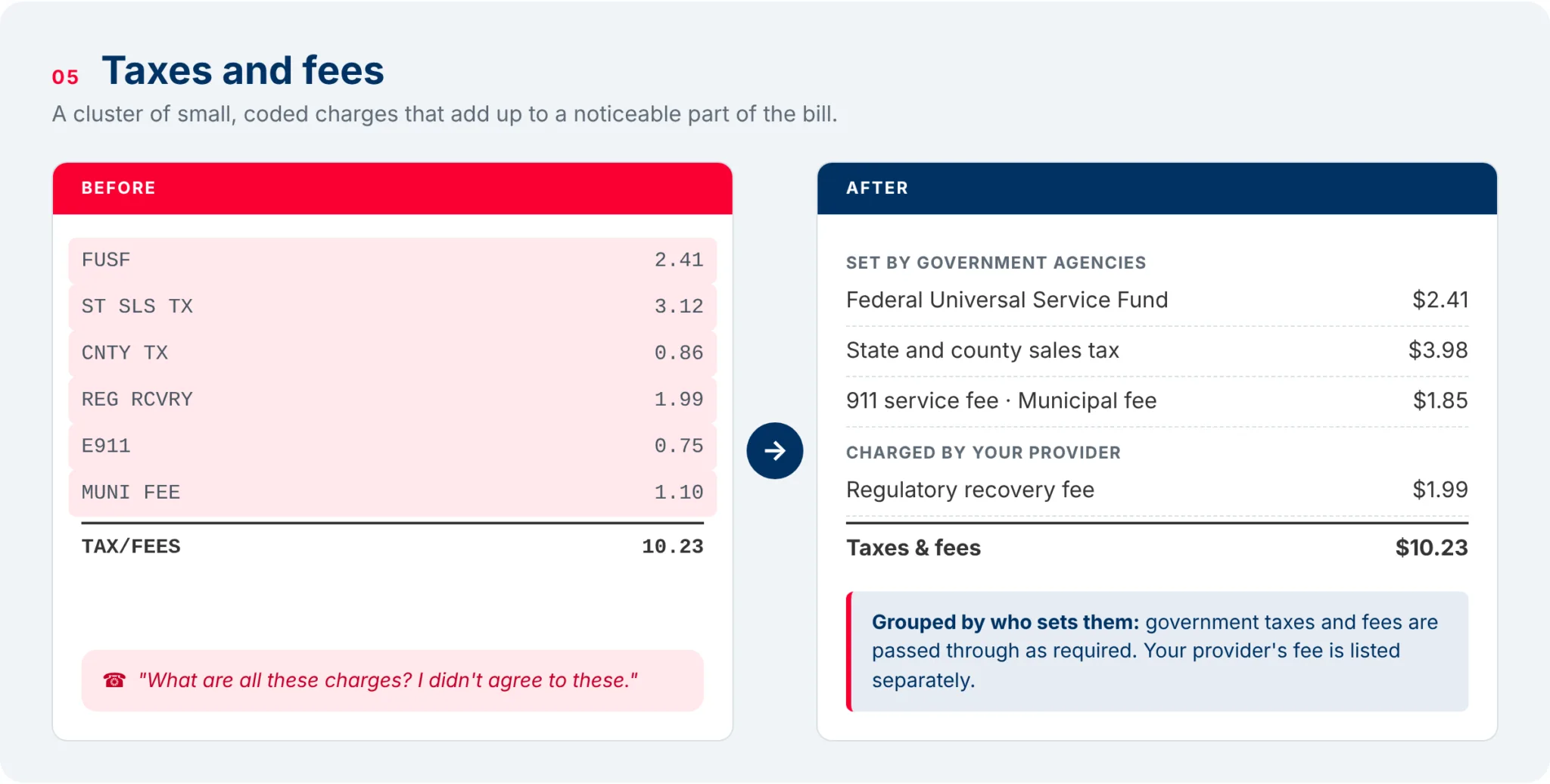
None of these are complex billing scenarios. When the explanation sits next to the charge, many of the calls that charge would have caused never happen.
Put the Total Due First
One layout change matters more than any label: show the amount due at the top of the statement, clearly labeled, before any line-item detail. When customers have to work through taxes, prorations, and credits to find the number they owe, some of them give up and call.
Billing Contact Rate: The Number to Track
Overall call volume can’t tell you how well your invoice is working. A better measure is the billing contact rate:
Billing contact rate = billing-related calls ÷ bills issued in the same cycle
For example, a provider that issues 18,000 bills and receives 900 billing calls that cycle has a 5% billing contact rate.
To make the number useful, have agents code calls by reason. At minimum, separate “customer didn’t understand the invoice” from “actual billing error.” Without that split, confusion and errors look the same in the data, and you can’t tell which fix to apply.
Tracked over time, the rate shows patterns that aggregate call data hides:
- A large group of promotions expiring in the same cycle shows up as a spike.
- A new service with a confusing label keeps the rate high until the label changes.
- An invoice redesign shows up as a lower rate within a few billing cycles.
That gives you a feedback loop between invoice changes and support costs, so design decisions can be measured like any other operational change.
[Optional: add a client result here, for example: “One MACC client, a [size/type] provider, lowered its billing contact rate from X% to Y% over Z cycles after relabeling charges and adding promo-expiration notes.”]
Where Your Billing System Helps, and Where It Limits You
Everything above depends on how much control your billing platform gives you over the statement. A well-designed platform lets operations teams change how charges appear without rebuilding the rate structure underneath. Plain-language labels, consolidated line items, and explanatory notes become configuration settings rather than custom development projects.
When the platform doesn’t support that, teams work around it with bill inserts, outbound emails, and IVR messages that explain what the invoice should have explained. Those tools are legitimate, but they treat the symptom after the bill has already gone out.
MACC | ONE brings billing, provisioning, customer management, and reporting together on one platform. That makes it easier to see, and control, the connection between how a charge is configured and how it appears on the customer’s statement. MACC also offers personalized video summaries and explainers that walk each customer through their own bill. A new subscriber can watch a short video that explains their first invoice, including the installation charge, the partial month, and what next month’s bill will look like, before they think about calling. The video covers the moments a printed note can’t fully handle.
If your team is relying on manual workarounds to fill gaps like these, the Swivel Chair Score can help you measure how much those workarounds cost across your operation.
FAQ
How do we tell invoice confusion apart from real billing errors?
Code calls at the agent level. Add a billing reason category that separates “couldn’t understand the invoice” from “billing error,” and within two or three cycles you’ll have clean enough data to target the right fix.
Can we change how charge codes appear without rebuilding our rate structure?
Often, yes. Some platforms let you map plain-language display labels to charge codes, so the rate logic stays the same while the customer-facing text changes. Others tie the label directly to the code, which makes relabeling harder. Ask your billing vendor specifically about output configuration.
What’s a good billing contact rate benchmark?
Rates vary too much across service mixes and customer bases for an industry average to be useful. Set your own baseline over three to four cycles, then track the trend as you make changes.
Is the first-bill spike an invoice problem or an expectations problem?
Usually both. Sales and onboarding set the expectation, and the invoice either confirms it or contradicts it. Tell customers during onboarding that the first bill will be higher, and label each one-time charge on the statement. Fixing only one of the two reduces the spike, and fixing both reduces it much more.
If we simplify the invoice, will customers miss charges and dispute them later?
Clear invoices tend to lower disputes. The bigger risk is the opposite: customers who pay bills they don’t understand often dispute them months later. A statement that explains each charge gives both sides a shared record.
The Bottom Line
Post-bill calls follow a pattern because the invoice follows a pattern. Fix the five line items that cause the most confusion, put the total due first, and track your billing contact rate so you can see the results. Your support team will spend less time explaining the same charges every cycle and more on questions that need a person.
Want to see what this looks like on your invoices? Talk to the MACC Client Solutions Team. They’ve worked through these scenarios with providers in situations like yours.